
Getting to the last row: relays vs delays
In large-format sound reinforcement, coverage consistency is never accidental. Whether it’s an outdoor festival stretching hundreds of meters past front of house or a stadium pushing audio into the highest tiers, the challenge remains the same: delivering controlled, intelligible sound to the last row without excessive level variance.
At the core of this problem is a simple physical reality—a 6 dB loss for every doubling of distance. No amount of DSP or array optimization changes that rule. If a system design goal is even SPL across the audience plane, there comes a point where the main system alone can no longer carry the load. That’s where secondary systems enter the conversation.
Broadly speaking, there are two primary approaches to extending forward coverage: delay systems and relay systems. While the terms are sometimes used interchangeably in the field, they describe two distinct philosophies of system design.
Delays
Often seen at large scale festivals or even in installations such as under or over balcony fills in places like houses of worship this system design is characterized often by sources placed directly in line with the main system, where the main system fires sound from one source directly into the back of another.
Your delays are often main system number two. They can frequently be found in line with the mains in a system where the main system fires into the back of the delays. From there time delay is added so that by the time the main system reaches the delay, the sound from the delays is combined with as close to perfect summation as possible to allow the combined sound to travel further into the venue.This solution extends forward coverage allowing sound to travel further across an area by restoring level loss over distance. This is a common approach outdoors when things like direct to reverberant ratios aren’t as much of a concern as they would be indoors. The goal is not to create a new listening zone, but to support the main system as it loses energy over distance.
Delay placement is largely dictated by the capability of the main system. Loudspeaker selection, array length, and overall directivity determine how far the mains can carry before reinforcement becomes necessary. As a practical benchmark, many designers aim to place delays at the point where the main system has lost no more than 6 dB. This helps ensure a smooth transition with minimal perceptual impact for the listener.
The delay system is a true extension of the main system, timed precisely so the addition is inaudible.
Relays
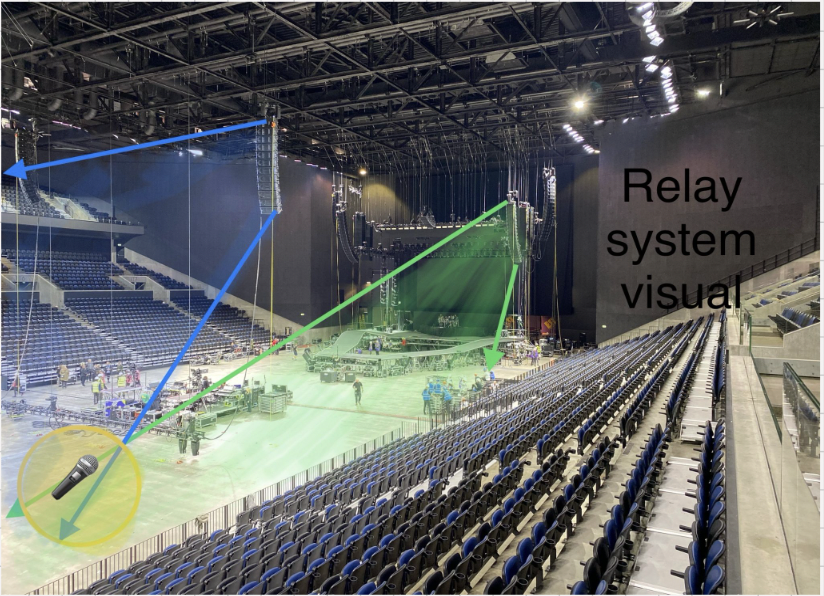
Much like our delay systems, relay systems also gain us forward extension. They work by breaking an audience area up into “zones” and having an array cover each zone that is connected with small amounts of overlap, and woven together with time delay.
Visually, relay systems are often easily identified by hangs of loudspeakers aimed downward rather than firing long distances forward. Each array covers a defined area, then passes coverage to the next system further back.
This strategy is common in extremely large venues or in situations where deploying very long arrays is impractical. Rather than pushing a single system to its limits, designers distribute coverage across multiple sources, each optimized for its specific throw distance and audience area.
Relays are running a race. They pass off coverage like runners sprinting around a track passing a baton. The coverage zones act as the baton, being handed off from one array to another. As sound loses level over distance we find an additional source as if playing a game of leap frog where sound is jumping from one array to another.
The relay system approach is often used in large indoor venues due to the advantage of improved direct to reverberant ratio, and often a more consistent tonal result when hangs of the same line length are deployed across different locations.
Considerations
Both delay and relay systems exist to address the same constraint: physics. Sound decays, and audience expectations for consistency continue to rise. The distinction lies in how that decay is managed.
The decision between relay and delay approaches depends on several factors:
- Venue size and geometry
- Indoor versus outdoor conditions
- Loudspeaker performance and array length
- Rigging limitations
- Desired SPL variance across the audience
Ultimately, effective system design is about knowing when to reinforce, when to hand off, and when to let the system breathe. When executed correctly, the audience never notices the mechanics behind the coverage—they just know the mix holds together from the barricade to the back wall.
And in large-scale sound reinforcement, that’s the metric that matters.
Conclusion
Whether you’re at a large scale festival looking at miles and miles of people, trying to hear the music coming from the stage, or a stadium show, and trying to get sound to the last row, the use of delays in large scale system sound systems is easily recognizable. Regardless of the approach used to restore level loss across an audience area it’s important to consider the main principle of level loss, which is that we will lose 6 dB of level for every doubling of distance. Either way, if we’re trying to have a low variance system with the same level in every seat then at some point if we’re trying to make sound travel a great distance we’re going to need some help.