
Considering Context in the use of shared infrastructure in live events
Shared infrastructure built around network switches, fiber optics, and distributed systems is rapidly becoming the future of live events and touring. Increasingly, productions are moving beyond department-specific infrastructure and embracing shared networks that serve multiple disciplines simultaneously.
Rather than deploying traditional copper snakes across a venue, many productions now run fiber and utilize local power at each endpoint. This approach can significantly improve efficiency in venues ranging from arenas to stadiums. While these systems require careful planning and a higher level of technical competency, the benefits can be substantial. With proper advance work, strong project management, and often a dedicated “fiber department,” shared infrastructure can efficiently distribute internet connectivity, transport audio and control data, and support wireless communications systems such as Riedel Bolero throughout an entire site.
Single mode vs mutli mode fiber
One of the first questions to consider when deploying shared infrastructure is the type of fiber being used.
Single-mode and multimode fiber differ in several important ways, including the wavelengths of light they utilize and the physical size of their cores.
Single-mode fiber typically operates at wavelengths around 1310nm and 1550nm, while multimode fiber commonly operates at 850nm and 1300nm. The larger core diameter of multimode fiber allows multiple light paths, or modes, to travel simultaneously. While this can simplify some applications, it also limits transmission distance and bandwidth performance when compared to single-mode fiber.
As a result, multimode fiber is generally best suited for shorter-distance applications. Single-mode fiber, by contrast, can transport data over distances measured in kilometers while maintaining excellent signal integrity.
When implementing a shared fiber infrastructure, it is important to calculate both the total fiber length and the longest individual signal path. If multimode fiber is being used, exceeding recommended distances can result in signal degradation or insufficient optical power levels. For most communications and live-event applications, single-mode fiber has become the preferred standard due to its flexibility and long-distance capabilities.
However, not every device supports single-mode operation natively. Some audio consoles and network devices ship with multimode optical interfaces by default. In these situations, productions may need to use media converters or devices such as the Optocore M8 Opto, or replace optical transceivers and interface cards to match the fiber infrastructure being deployed
documentation matters
The success of a shared infrastructure deployment depends heavily on documentation.
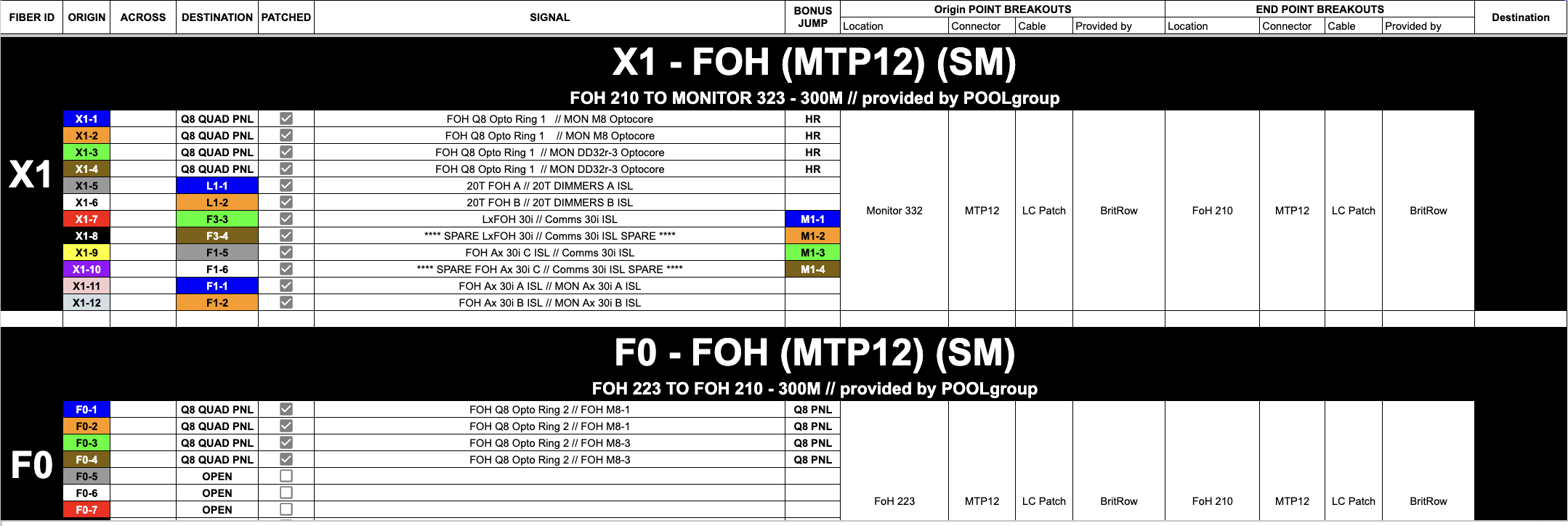
At minimum, productions should create a fiber worksheet detailing cable runs, strand assignments, connector types, and endpoint locations. Larger productions may benefit from a comprehensive technical book that documents network topology, VLAN assignments, switch configurations, fiber patching, and redundancy plans.
Clear documentation not only speeds up deployment but also simplifies troubleshooting and communication between departments.
See an example in the image below.
Pros and cons
Like any technology, shared infrastructure comes with both advantages and disadvantages.
Advantages
- Fiber is significantly lighter than traditional copper snakes, reducing labor and potentially saving truck space.
- Long-distance connectivity can be established with fewer cable runs.
- Additional departments can often be connected simply by adding a network switch.
- Fiber supports flexible infrastructure designs, making unusual cable routes and long distances easier to accommodate.
- Cable runs can extend well beyond the practical limitations of copper-based systems.
- Once a shared network is established, resources such as internet connectivity, communications systems, and control networks can be distributed efficiently throughout a venue.
Challenges
- Fiber is more fragile than traditional copper cabling and requires proper handling and regular cleaning, particularly in dusty or outdoor environments.
- Successful implementation requires advanced planning from both the touring production and the venue.
- Venue-provided fiber may not always match production requirements. Differences in connector types (duplex, quad, MTP, etc.) or fiber mode (single-mode versus multimode) can require additional adapters, converters, or replacement cabling.
- Language barriers and varying levels of local crew experience can complicate deployments, particularly when working with sensitive connector formats such as MTP.
- Troubleshooting fiber systems often requires specialized tools and personnel with networking and optical transport experience.
Why Context Matters
There is no universally correct approach to infrastructure design.
Traditional copper snakes and modern network-based systems each offer distinct advantages depending on the environment, budget, timeline, and technical requirements of a production. While a fully fiber-based infrastructure can be deployed successfully in challenging environments—including outdoor festivals and temporary sites—it may not always be the most practical solution.
A muddy festival field, for example, presents very different challenges than an indoor arena with permanent infrastructure. In some cases, the robustness and simplicity of traditional copper may outweigh the benefits of a fully networked approach. In others, fiber may dramatically reduce labor, improve flexibility, and enable capabilities that would otherwise be impossible.
The key is understanding the context of the event and selecting the infrastructure that best serves the production’s specific needs. Shared infrastructure is a powerful tool, but like any tool, its effectiveness depends on how—and where—it is used.