Shed Season: Considerations for touring outdoors
Amphitheaters and sheds occupy an interesting middle ground in live sound touring. When it comes to doing live shows outside it’s hard to ignore, that your day to day show often changes far more than in almost any other type of touring. They have roofs, stages, grids and infrastructure that make them feel like indoor venues, but in many ways we’re still working outdoors. As a systems engineer we have to contend with rigging limitations, weight restrictions, sightlines, house PA integration, changing atmospheric conditions and, ultimately, weather.
Design around the constraints
Shed season is an exercise in working within constraints. Planning ahead and considering how shed tours are unlike any other type of touring can help set you up for success on your next outdoor run.
More often than not given the nature of most amphitheaters you’ll commonly find weight restrictions, limited rigging options, or at times just narrower stages with narrower grids. Sometimes if we’re lucky we can begin to place PA offstage away from the rest of the show, but as time goes on the dedicated PA bays for rigging are certainly a luxury. Weight considerations often lead to doing less with more. From a design perspective I try to work backwards as much as possible especially with rigging constraints. This looks like starting from these questions in this order:
- Where can I physically hang this PA?
- What is the hook height/ maxim trim height?
- Are there any weight restrictions?
- What does the roof prevent me from doing?
- What can the house system take over?
These questions help me understand how much PA I can physically hang, where it can go, and what I should prioritize to have the best sonic experience in what can be a less than ideal environment for sound in a venue.
Additionally lower roofs and taller stages often lead to sightline considerations becoming a larger conversation. As a personal rule of thumb, I try to maintain at least eight feet between the highest point on stage and the bottom of the PA, with 12 feet being preferable when the venue allows for it. Furthermore, concrete, metal, and sloping roofs often make it a good idea to trim as high as you need to without shooting into the roof unnecessarily. Concrete and metal roofs can create strong reflections, so I generally want to get the PA as high as necessary for coverage while avoiding unnecessarily exciting the roof. A good general practice in the mornings is to walk into the venue, measure and draw the room, and then find the height of the lowest obstacle that will obstruct sound from your system and try to stay under it if possible.
Let the house System help
However, it’s important to note that we don’t always have to do everything with our own PA. Thankfully these days most amphitheaters have their own fill systems. So at times for sightline considerations, and the purposes of keeping tour managers happy we end up hanging fewer boxes and a greater reliance on house fill systems is required.
When using house systems to help fill in gaps in our coverage, or even just creating a smooth handoff in terms of which parts of the venues are covered by what speakers, the first question I ask is, “where does your house system cover”? Followed by, “where does this coverage start”? This tells me where in the venue I should start to lighten up coverage with my tour PA, and start to hand off to the house system. That might mean opening up the upper angles of the main array, to reduce the contribution of the tour PA in the area of overlap between the lawn system and the main hang to so we can mechanically start to “crossfade” between the two systems over the area of coverage by both systems to give us more of a seamless transition. Then I want to match the tonality of the house PA to the tour PA as closely as possible so we get as physically close as we can to having the same sounding show in every seat, even on the lawn. Finally my last step is to time the house system to the tour PA so that the transition feels intentional and localization remains as consistent as possible.
Most commonly tying into house systems to support the tour system looks like tying into various fills ranging from lawn delays, to VIP fills, and over or under balcony fills. More often than not utilizing them can save you a lot of headache. Especially when you’re trying to get sound more than 300’ away from you and you’re potentially running out of gas before you get to the back row with your tour system alone. However, how easy your day is tying into house systems often relies on how you work with your house audio engineer for the venue you’re in that day. When working with house audio and tying into house audio systems there are a few questions I always start with. First one being, “can you point out to me all of your speakers I’ll be tying into? Followed by, “How much time is on that system and where are they timed to in the venue (usually the answer is downstage center, or the house PA points)?” Finally I end with, “Would you like a mono or stereo feed from me, do you need an ADA line, and what restrictions should I be aware of if any?” Usually at this point they’ll be able to tell you about any “gotchas” in their venue that are common issues they see as well as any SPL limits or anything to just generally be aware of. Friendly reminder to be kind, as often house engineers can know their venue pretty well and with a little respect they can save you a lot of time and heartache trying to have a good show.
remeMBER THAT YOU’RE STILL OUTSIDE
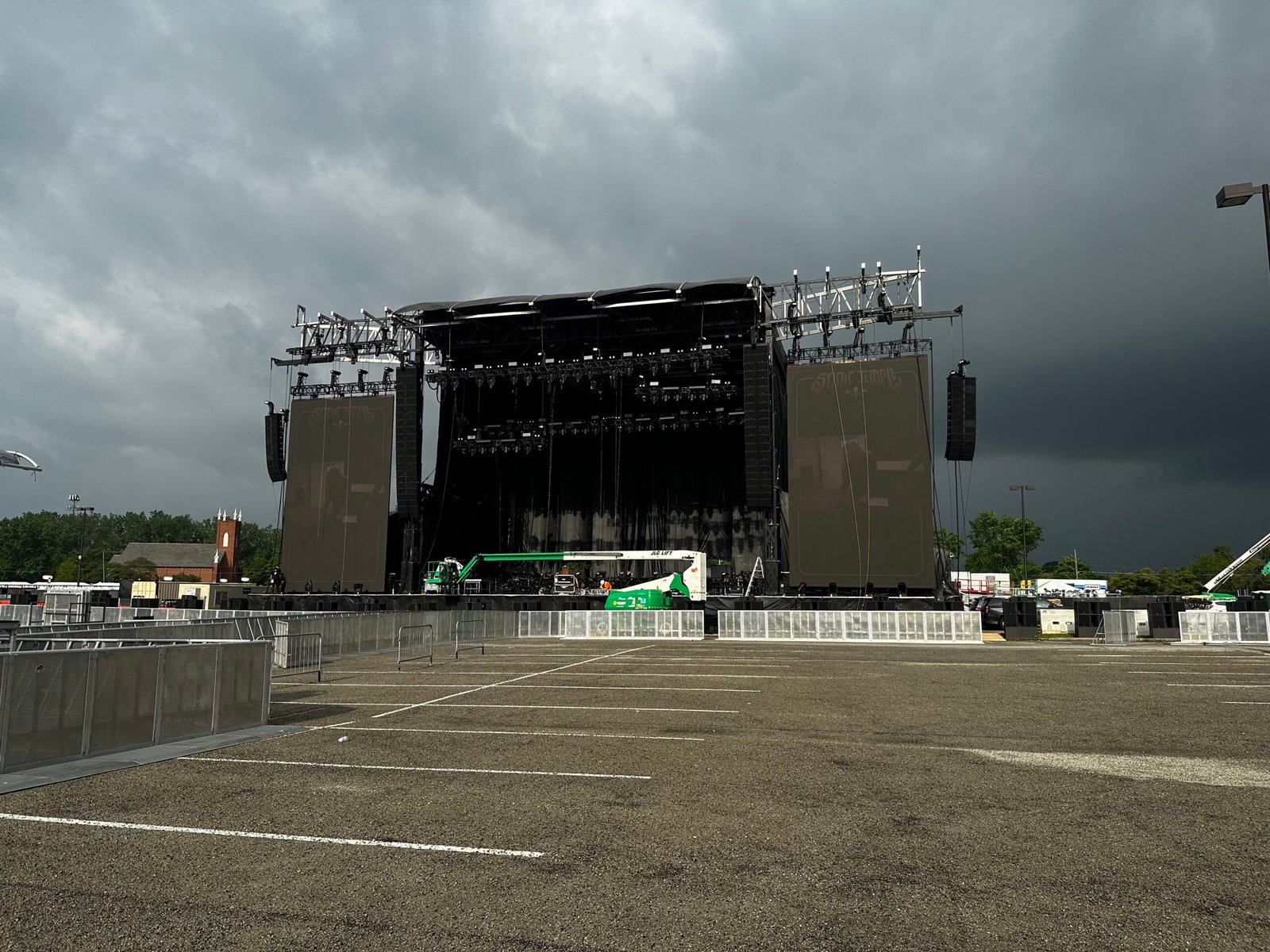
One last thing to consider when working on a shed tour is that despite the roofs and walls, in a lot of ways we are still essentially outdoors. This means that our sound is traveling through a constantly changing environment. Most notably I personally track temperature and humidity. I carry a HT1 sensor but any thermometer and hygrometer will do. I take note of the time, temperature and humidity when the PA is tuned and soundcheck is over. I know that after sound check this is my baseline tonally. From there as temperature and humidity change so does atmospheric absorption of sound (especially at high frequencies). Therefore, the system we tuned at 3pm may feel different when the show starts at 10pm. If we are using any type of air compensation or beam steering like Arrayprocessing we need to make sure that our temperature and humidity settings in our control software stay accurate and matched to our real world environment. Additionally, even when the show isn’t rained out, rain changes the acoustic environment. Wet surfaces can alter reflection and absorption characteristics, while the rain itself and accompanying atmospheric changes can affect what you’re hearing. Always have tarps or visqueen available to cover racks and equipment. I am a big fan of having contractor sized trash bags on standby to cover frontfills and their connectors.
HAVE A WEATHER PLAN BEFORE YOU NEED ONE
This means that our show should have a weather plan in case of emergency. Work with your rigger and production manager to create a high wind action plan for when to land the PA, as well as a show stop procedure for audio if for any reason there is a severe weather event or lightning. In the event of an emergency the PA still serves as the primary way to get information to the audience, so as the systems engineer, you don’t get to treat weather as someone else’s problem. You need to know the venue or tour’s weather policy, evacuation procedures, shelter locations, and who has authority to stop the show.
Shed season can be one of the most rewarding parts of touring because every venue asks you to solve a slightly different problem. The best solution isn’t always the biggest PA, the highest trim, or the most control we can put in the air. Sometimes it’s knowing where to let the house system help, when to change the design, and when the environment itself has to become part of the plan. Outdoor touring is ultimately about understanding your constraints before they become problems and designing the system, and all of the plans to support the system and take care of it accordingly. Shed season can be a lot of fun, but acknowledging the differences in this type of touring can help us set ourselves up for success and continue to have great and safe outdoor shows.