
Tuning Versus toning a system
A few years ago, I wrote an article called “The Art of Data,” where we discussed why a technically correct sound system is not always the best sound system. I want to take that idea a step further and talk about what that distinction looks like in the practical, day-to-day workflow of a systems engineer.
For me, the process starts with tuning. But it does not end there.
Building a Correct System
I always start by putting out my measurement microphones. For a main PA hang, I typically establish four measurement positions along the on-axis coverage of the array. I start with the main hang and work to get it into what I would call a low-variance state.
The goal is simple: the top of the array should sound like the bottom of the array.
We are looking for consistency in both level and frequency response throughout the coverage of the hang, with particular attention paid to the high frequencies. We use a variety of tools to accomplish this, but EQ is usually one of the most effective.
Once the main is behaving the way I want, I repeat the process for the sides, 270s, and any other hangs that make up the system.
After that, we start looking at time.
I level-match and time-align the ground subs to the flown subs, then establish the appropriate timing relationship between the mains and whichever subsystem represents the latest arrival. From there, I work through the rest of the system: mains to sides, 270s, delays, and finally front fills.
By the end of this process, I should have a system that is technically correct, time-aligned, and consistent throughout the listening area.
At that point, I should be able to put on music, walk around the room, and hear essentially the same tonal character and relative level throughout the space. In a well-designed system, I am generally looking for that experience to remain consistent front to back, ideally within roughly 6 dB of variation.
That is tuning. At this point, we could call the job finished.
When the System Is Correct, But Doesn’t Feel Correct
Now we have to consider how the system feels.
I don’t mean asking whether the PA is happy or sad. I mean asking what it feels like when you actually turn it on and experience it as a human being.
Is it impactful? Is there clarity?
Does what I’m seeing match what I’m hearing?
Does the system feel too far away? Too close?
Does it feel natural, or does it feel forced?
These are not purely mathematical questions, but they are just as important.
We can start with the room. Are there frequencies that seem to hang around too long? Are there areas where we have too much energy? In certain rooms, particularly those with challenging acoustics, I often find that low-mid energy can build up and become overwhelming, masking the very information we are trying to preserve.
Then there are situations where the system is technically correct, appropriately timed, and objectively behaving the way we asked it to, but the experience still feels wrong.
One of the interesting examples is a system with a significant amount of delay.
Technically, that delay may be exactly what is required to get every speaker to arrive at the right time. Psychoacoustically, however, the system can begin to feel farther away than it visually appears.
That is where we can start using what we know about perception.
Sometimes giving a little more energy back in the high frequencies, or emphasizing a frequency range that provides a stronger sense of presence, can make the system feel closer without changing the actual propagation time.
We are not breaking the physics. We are working with the way people perceive sound.
That distinction is important.
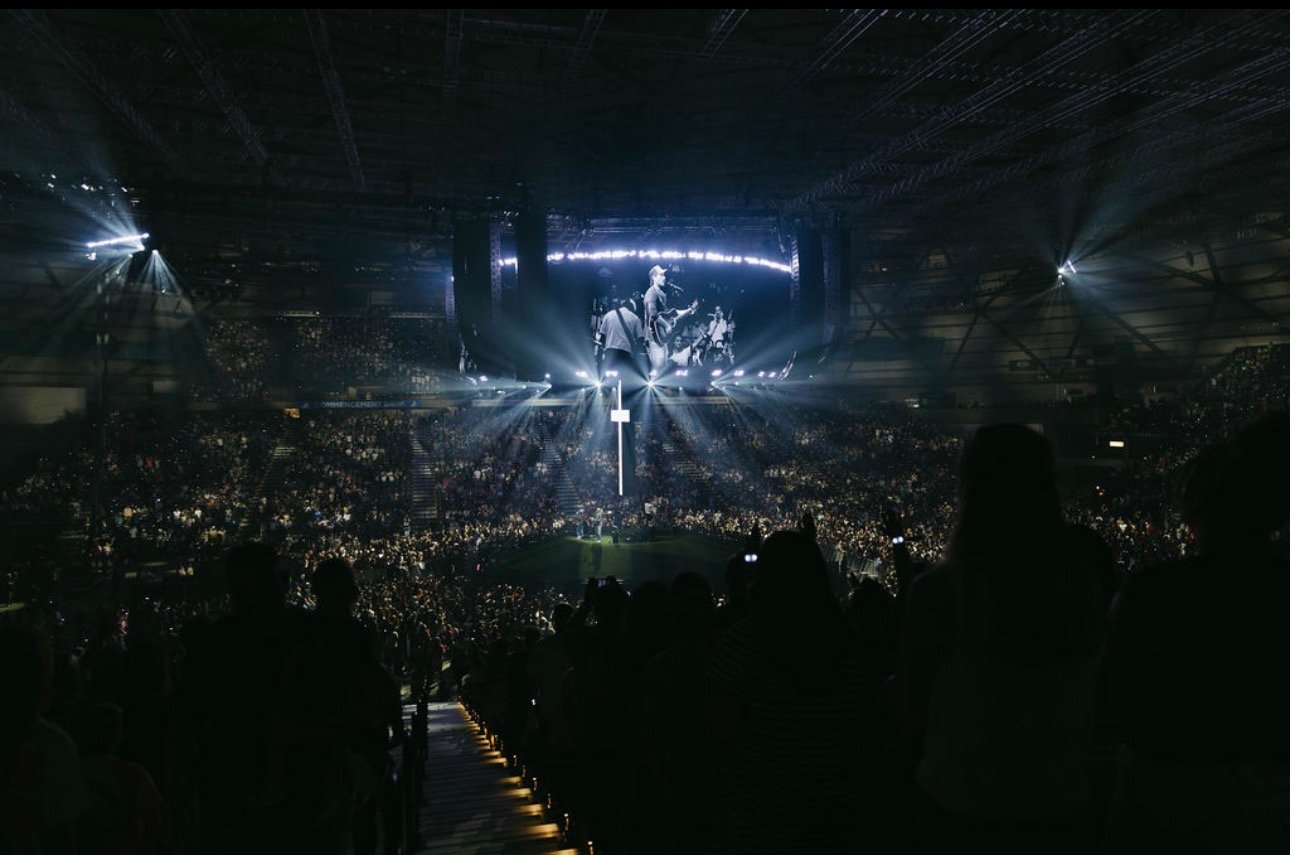
Tuning Gets Us to the Blank Canvas
At this point, we’ve done most of the work that makes a PA technically correct.
It is aligned. It is consistent. It has the appropriate relationships between the different parts of the system.
We have addressed obvious room problems and made the system feel like it occupies the appropriate space. Now we should have something close to a blank canvas. But even a blank canvas needs to be the right shade of white. This is where I draw the distinction between tuning and toning.
Imagine standing in the paint aisle at Home Depot looking at 17 different shades of white. Technically, they’re all white. But they are not the same white.
Toning a PA is similar. We are no longer asking, “Is this system correct?”We are asking, “What should this correct system sound like for the show we’re about to do?”
This is where context starts to matter. For a rock-and-roll show, I want to make sure the subs have the appropriate level and that the overall tonal tilt of the PA supports the experience we expect from that genre.We want it to feel like a rock show.
That can absolutely be evaluated by ear, but I also like to use data as a reference point. One of the ways I do this is by looking at C-A averages over time. Personally, I often use a one-minute average as a useful snapshot of where the system is living during the show.
For a pop show, the priorities may be different. We may want more support and definition in the upper frequencies for tracks, vocals, and all of the other “sparkly bits,” as we sometimes call them. Maybe the system needs to be warmer. Maybe some low-mid energy needs to come out. Maybe the subs need to come up. The important thing is that these changes are made intentionally.
Toning a system is not about randomly EQing a PA until we like it. It is about understanding what the show needs and handing the mix engineer a system that helps them get there. The goal is to get the engineer as far ahead as possible without taking away creative options.
There is another important consideration here: the system is not operating in a vacuum.
Things change. Frequency changes over distance with temperature and humidity. The audience changes.
We talk a lot about how a room changes once 10,000 people walk into it, and that’s true. But 10,000 people also means a significant change in temperature, and temperature affects how sound propagates through the air.
That means a system that sounds perfect when the room is empty at soundcheck may not behave exactly the same way once the room is full and the environmental conditions have changed.
This is one of the reasons I am careful about how much compensation I apply when toning a system. We can get ahead of the engineer by making smart decisions early, but we can also hurt them by trying to compensate for every possible change before it happens. The trick is not to take away more than you need.
Good Versus Great
Tuning a PA is important. We want systems that are technically correct, time-aligned, and consistent throughout the listening area.
But I think the difference between good systems engineering and great systems engineering is what happens after that work is done. A good systems engineer can build a technically correct PA. A great systems engineer can build that same PA, step back, listen to it, understand the room and the show, and then tone it so that the system feels correct.
More importantly, they can hand that system to the engineer in a way that gives them the biggest possible head start toward making the best show of the day. The technical work gets us to the blank canvas. Toning decides what shade of white that canvas should be. When we get that part right, the system doesn’t just measure correctly. It feels right.